Tuesday, November 16, 2010

Applying compost tea


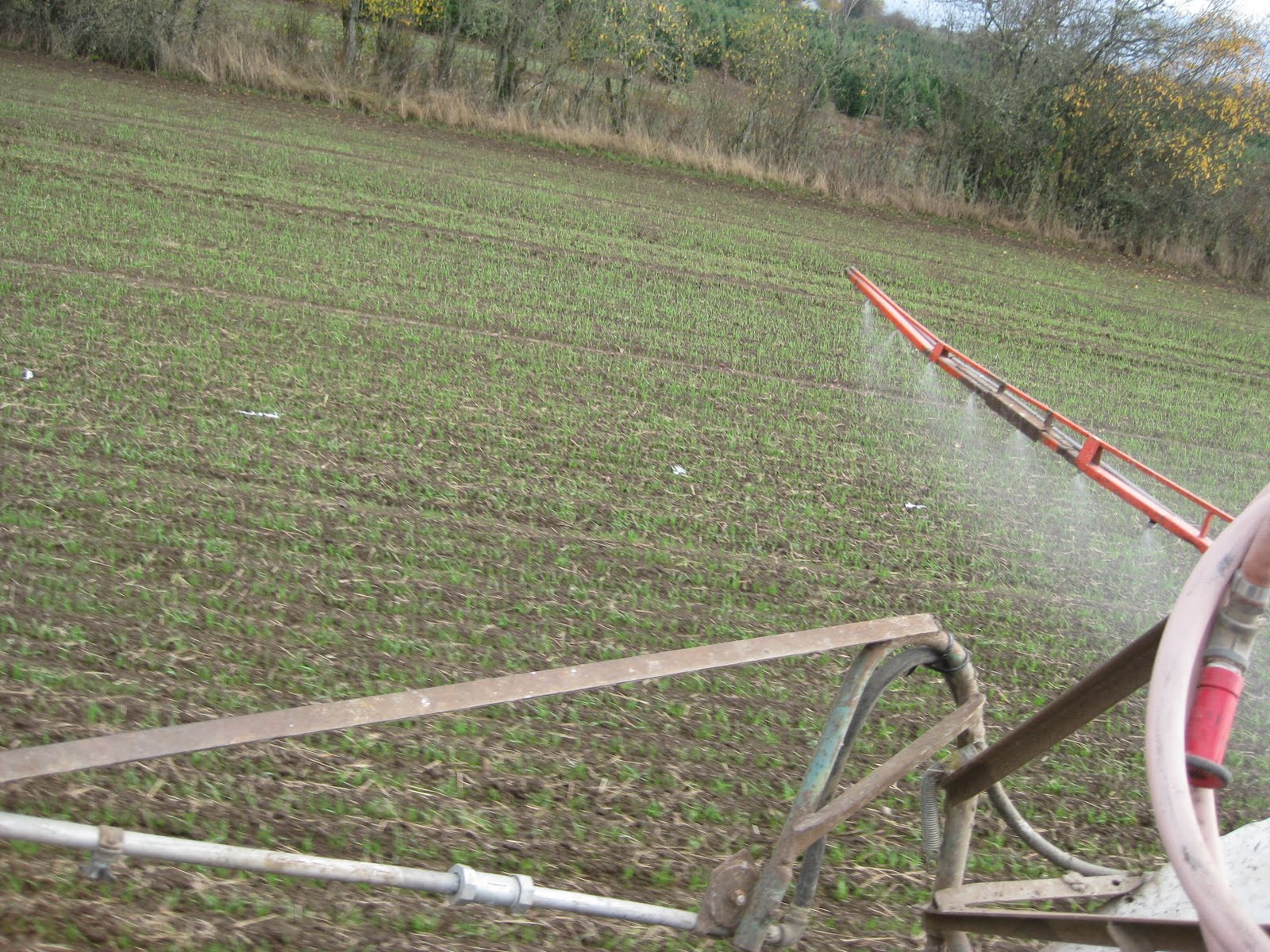
Over the past 2 weeks I have been making and applying our own compost tea. I am still experimenting with different recipes and seeing what kind of results I can get. The idea is to get the highest quality tea at the lowest price per gallon. I have used several different people's solid compost. Harry MacCormack's leaf, Shepard Smith's compost, and Joe Richard's vermicompost. I have used various things as food: Hendrikus Organic's Organobloom 5-2-4, EarthFort's Solu-Plks and Acadian Kelp, and fish from Bob Wilt. The first batch had zero active fungi so I didn't apply it. It hindsight I wish I had, as the bacterial counts were good and you don't necessarily need high fungal counts all the time. The second batch I used a recipe from Soil Foodweb and pretreated the compost for 3 days with fish and Solu-Plks. The results that came back were very good, but the cost of the ingredients is very high. I am trying to find out if I can get good tea without using the kelp or pretreating the compost. The kelp is extremely expensive, about 167 dollars for 10 pounds, and it takes 5 pounds per 1200 gallon batch. Pretreating helps increase the fungal counts, but it takes an extra 2 or 3 days. Having that much time between batches is difficult this time of year when every patch of good weather has to be taken. I am waiting on the test results from my latest batch which was made with Joe Richard's vermicompost, 40 oz of fish, and 80 oz of Solu-Plks. I have been applying the tea to our higher value ground first. That is to say the wheat, peas, and flax. The grass seed ground is a lower priority but is still important. Due to various hang-ups with getting the brewer up and running and figuring out a recipe that works we are a few weeks behind schedule on spraying. After this fall application we will not spray again until the spring.

Planting winter peas as a cover crop


This fall we planted about 75 acres of golden and green peas as a winter cover crop. Having a legume in the ground over the winter will help increase the nitrogen in the soil for the next crop. It also helps prevent soil erosion. Not only are these peas going to provide nitrogen-fixing and "green manure" benefits, but we are being paid by the NRCS to put them in. The fields with the peas have now been limed and sprayed with compost tea in addition to the planting of the peas. The fields should provide us with much better yields on our next crop of wheat or oats.

Monday, November 1, 2010

Grain mill construction progress


Construction of the large grain mill at our warehouse is progressing well. The building is taking shape and the main equipment has been delivered. Electrical work will proceed soon. We hope to have our 1000 pound per hour mill up and running within 6-8 weeks at the earliest. Thank you to Rick Laymen for the carpentry, and Willow Coberly for keeping us on our toes!

Fill-Your-Pantry Market a HUGE success! Thank you!


Wow what a response! The market here at A2R Farms last Saturday surpasses all expectations with the huge turnout. Between 300-400 people came out looking to stock up on a wide variety of goods. We want to thank everyone who participated, including the planning group, the Bean and Grain Project, and all the farms who brought such wonderful food to sell! A2R had several snags such as lack of availability of processed product, poor visibility of pricing, and no separate line for pre-orders. Rest assured we will address all of the issues we had and be much better prepared next year! We have set a date of November 6th, 2011 for the next event. Here is a list of the product sold by A2R:

Hard Red Wheat Berries - 1139 lbs.
Soft White Wheat Berries - 251 lbs.
Brown Flax - 86 lbs.
Hulless Oats - 95 lbs.
Rolled Oats - 147.5 lbs.
Cayuse Oats - 29 lbs.
Soft White Flour - 99.5 lbs.
Hard Red Flour - 79 lbs.

Again, THANK YOU to all who came out!

Wednesday, October 27, 2010

Building a compost tea brewer


Over the past few weeks I have been working on putting together a compost tea brewer. Transitioning to organic farming necessitated a shift from conventional fertilizer and amendments to organic, and it made sense to build our own brewer after looking at how much use we would get out of it, not to mention how much money we would save. First, we looked at how much tea we would need for at least 2 yearly applications, one in the fall and one in the spring. All of our acres at the recommended amount of 15 gallons per acre puts our need at around 13,000 gallons per application if we did every acre. After looking at various tank sizes we settled on a 1400 gallon tank. When a batch is brewed in this tank we end up with around 1200-1300 gallons of tea. Our spray buggy holds approximately 450 gallons, so 1 batch of tea will give us nearly enough for 3 full buggy loads. 3 buggy loads will do about 70-75 acres. So one batch of tea a day will allow us to spray every acre in about 10-12 days. There are 3 main parts to the tank: The tank itself, the air pump, and the liquid pump. The air pump agitates and aerates the tea to allow the organisms to multiply. The liquid pump is for filling the buggy after the batch is done. I put a float valve on a fitting and attached a hose to it for filling the tank. It takes several hours to fill the tank to 1200 gallons. It took many, many trips to JTI Supply (the tank and fitting company) to get the correct fittings. We decided to put the air pump above the tank on a bracket to prevent backflow. We had previously tried putting it on the ground and looping a length of hose up over the tank to prevent backflow, but the head pressure in the tank was too great, and water flowed back into the pump. Next we tried a check valve between the air pump and the fitting on the bottom of the tank, but the check valve inhibited the air flow too much. When we put the air pump above the tank and turned it on with the tank full, it worked for about 2 hours until the air pump couldn't sustain enough air pressure to keep the tank agitated. Turns out the air pump can only perform with less than 65 inches of water. The tank, when full, is about 75 inches high. Because of this I tried putting another opening in the side to allow the air in. This worked but we determined that the agitation wasn't sufficient on the other side and the bottom of the tank. Ultimately we decided to put less water in the tank and keep the air coming in through the bottom fitting. This will also help prevent a layer of anaerobic organisms forming on the bottom of the tank, which could degrade the quality of the tea. I purchased a bag for the tea from Earthfort, a local company specializing in compost tea. The bag hangs down from a clasp on the underside of the lid, keeping it suspended in the middle of the tank. I used quick release fittings on all the connections to make cleaning easier, as biofilm on the inside of the tank, hoses, and fittings can harm the beneficial organisms in the tea. I started brewing the first batch of tea yesterday. I used 25 pounds of solid compost. About half is from Harry MacCormack at Sunbow Farm, and half is from Shepard Smith at Soilsmith Services. I also used about 28.4 pounds of 5-2-4 Organobloom as food for the tea. This is a very basic recipe that will probably need significant tweaking to get right. I'll take a sample in to Soil Foodweb for testing today when the tea is done brewing. If the results are acceptable we can start spraying tomorrow, although I'm sure I'll need to make some adjustments to the recipe to get it right. Big thanks to Joe Richard at JTI Supply for all the materials, Kevin at Earthfort for all the advice, Harry MacCormack at Sunbow Farm for the compost and great tips, and also Shepard Smith at Soilsmith Services for the compost.

Friday, October 22, 2010

Fall planting update.

We are close to finishing the fall planting. So far we have planted the following crops: Hard Red Wheat, Soft White Wheat, Brown Flax, Golden Peas, Green Peas, and Annual Ryegrass. We are trying to get more wheat planted in the fall this year, as we anticipate higher yields from the red when it's fall planted. The peas we planted as a cover crop. We will till them under in the spring, then plant wheat or oats or another spring crop on that ground. The peas act as a nitrogen-boosting crop, which cuts down on our fertilizer needs for those fields. We also had our 3 pea fields limed to raise their pH. They should produce a pretty good crop this year.

Tuesday, October 12, 2010

Product list for Fill-Your-Pantry Market here at A2R Farms on October 23rd.

Here is a link to the Ten Rivers Food Web's recent article on the list of foods available for bulk purchase at the first annual Willamette Valley Fill-Your-Pantry Market here at A2R Farms. More than half a dozen farms will be selling bulk quantities of winter storage foods such as grains, flour, beans, root vegetables, honey, canned fish, and frozen meat at very low prices. Local beer and wine, as well as live music, will be on hand. Support your local farmer! Click the title of this post to navigate to the list. Thank you and we hope to see you there!